
The Giver, by Lois Lowry, is a work of dystopian fiction. It is a work of fiction because it is a made-up story. It is dystopian because it is about an ideal world (utopia) that is not ideal (dystopian). Many people assume that dystopian novels are about horribe things. While I can’t speak for all dystopian literature, I can speak for The Giver and tell you that it is a story of what one person can do to change their world. At the very least, it is a Newbery Medal work by the same author who wrote Number the Stars and Gathering Blue.
Structure
A story has a beginning, middle, and end. It has a plot. It has plot points. All of which is to say that, whether or not the author planned it out ahead, there is an organizing principle as illustrated by a plot diagram, behind every story. Y
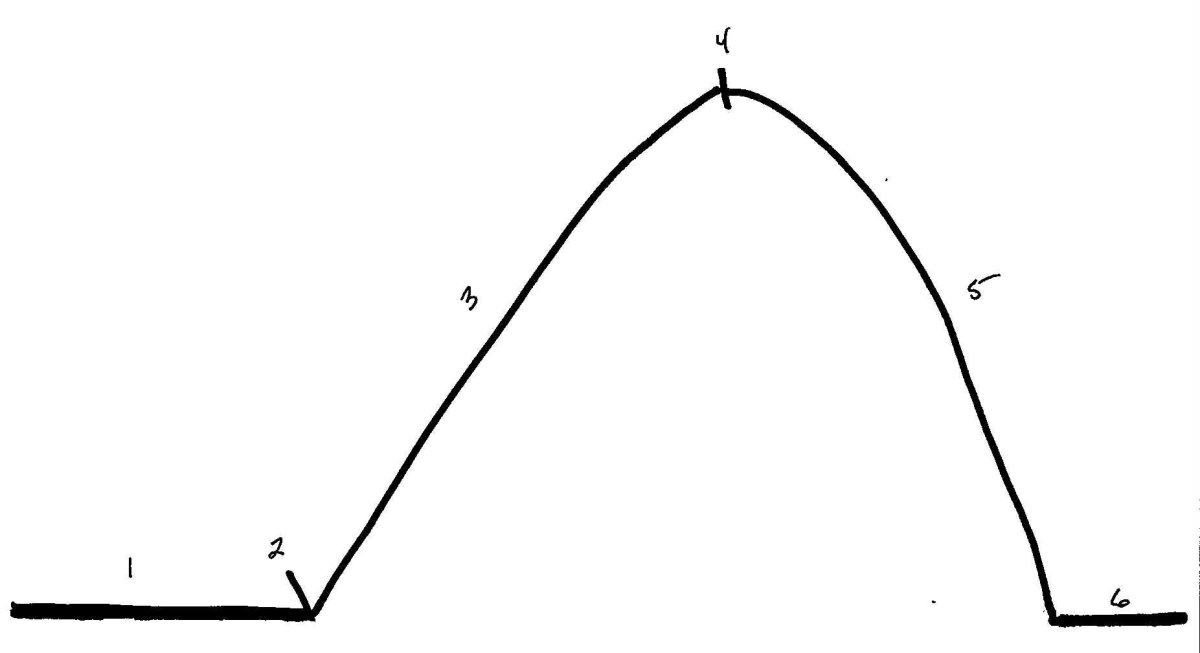
- Exposition
- Inciting Incident
- Rising Action
- Climax
- Resolution
- New Normal
The exposition gives the reader a look at what is normal for the character. The inciting incident is the event that changes everything; everything that happens after is because of the inciting incident. The rising action is the part of the story where the tension builds. At the climax, the tension is broken and we move on to the resolution, during which the “problem” is solved, and the tension falls. The new normal is what is now normal for the character.
Exposition
The exposition in The Giver is long and detailed. In the first seven chapters, Lowry lays it all out for the reader. She talks about an airplane that flew overhead, a baby that is not thriving, the personalities of Jonas and his friends, the way the family tells their feelings each evening, how it is that children come into a family, the milestones for each age, and more. Every bit is important to understanding why the changes ahead are important.
Helping
Most kids are going to need a hand with the vocabulary, the pacing, the attention to detail, and the time it takes to get into a book. Why? Because they’re used to seeing things on a screen where they don’t have to read about hair ribbons and hold that fact in their heads, or bicycles, or ceremonies – in a movie, someone else has done the job of picking the important points and putting them on the screen. The more you can help them to appreciate the details in this, or any other, exposition, the more you’ve done to help them on their way to reading with comprehension.
For kids who are used to visual presentations or short excerpts that contain the pertinent information, this can feel like a lot. Especially if they don’t understand many of the words. So, let’s give them a hand. Let’s walk them through the first seven chapters, stopping when they don’t know a word, helping them to take notice of important pieces of information about the storyworld. Let’s help them acclimate to Jonas’ world, get to know Jonas and his friends, and develop their own sense of anticipation for the inciting incident that will come in Chapter 8.
Bottom Line
How about telling your child you’ll read the book with them – either together or at the same time – and discuss each chapter with them along the way, and that when you’re done, you’ll have a movie night and watch The Giver film together. Later in the week, ask them how the events in the movie compared to the events in the book. It may be that it was spot on. It may also be that they see for the first time that their picture of what they read is differs in points that may or may not be important to them. Give it a try; see what they say.
Note: All three novels are currently availabe on Kindle Unlimited.